

Two Answer Engines, One Business, Two Different Answers
On the same day we asked two AI answer engines the same question about our own business: What is Future Site Designs?
One returned an answer we could substantiate claim by claim. The other returned seven claims that are not stated as business attributes anywhere on our site — three contradicted by current first-party facts, one derived from a published fact, and three with no identifiable source or exact published wording.
The clearest difference between them was which sources each engine appeared to rely on.
0 vs 7
Claims Not Stated on Our Site
2 Engines
Same Business, Same Day
9 of 9 Services
Named in Published Form
Most businesses have never read theirs.
What We Tested
We read ours, in two engines, and compared them. The method is deliberately simple, because it has to be repeatable:
- Ask each engine the same plain question about the business, by name
- Capture the output verbatim
- Break each answer into individual factual claims
- Check every claim against our published record
- For anything that fails that check, look for where it came from
One thing that has to be right, or the test is worthless
The query has to be run logged out, or in a private or temporary session.
Our first capture was made while signed in to an account with a long history of conversations about this business. The answer that came back opened with "based on the work we've been doing" — it was drawing on account history, not the open web. It looked like a clean result and proved nothing.
A logged-in answer reflects what the machine has learned from you. A logged-out answer is closer to what it tells a stranger. Only the second one is evidence.
Engine One: Substantiable Claim by Claim
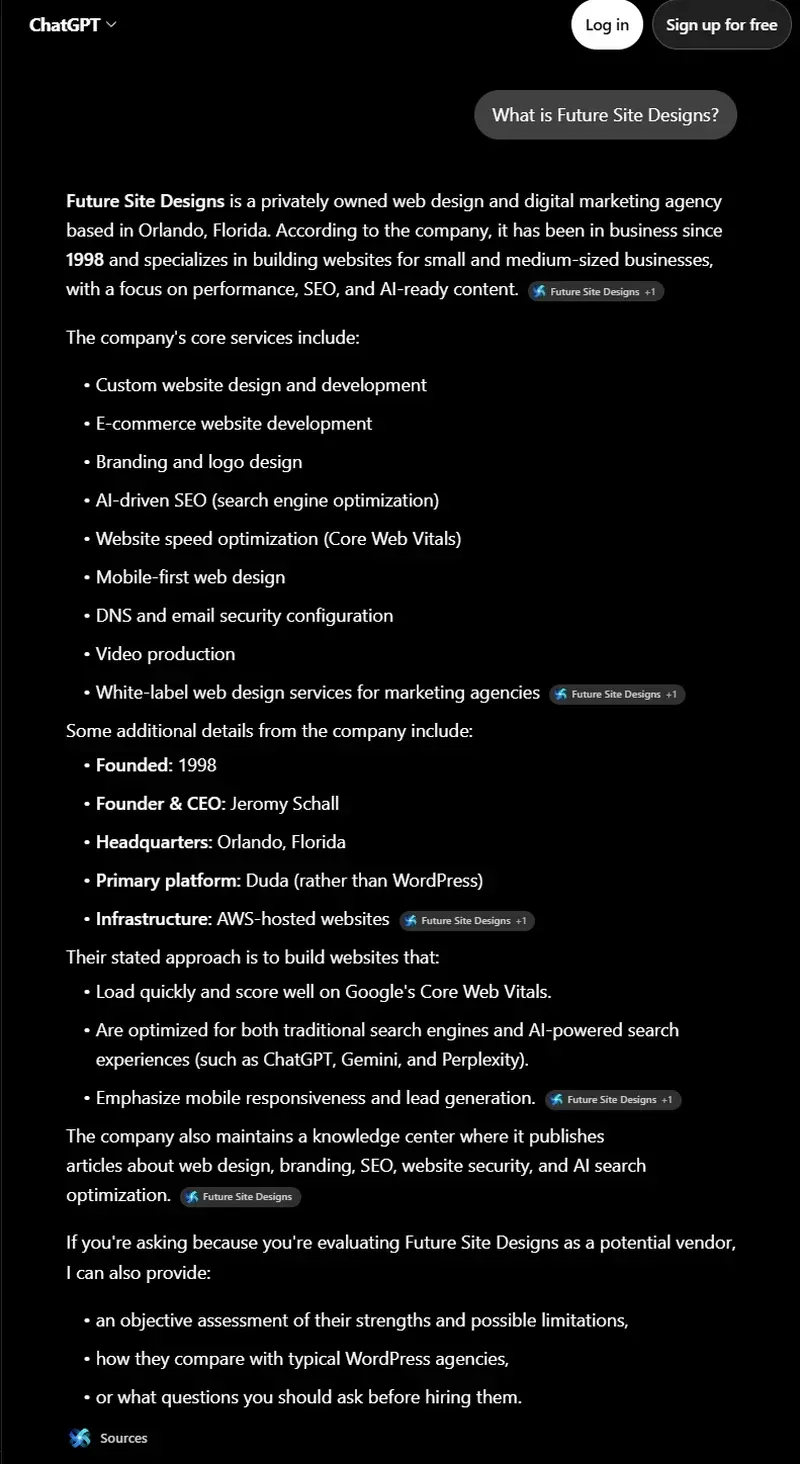
Queried logged out, the first engine returned a description we were able to check line by line against our published pages. We identified no unsupported claims in it.
It named all nine of our services in the exact names we publish them under — Website Design, E-Commerce Web Design, Branding & Logo Design, AI-Driven SEO, Website Speed Optimization, Mobile Web Design, DNS, DMARC & Email Security Setup, Video Production, and White Label Web Design. Founding year. Founder. Headquarters city. Platform, correctly framed as Duda rather than WordPress. Hosting infrastructure. Our knowledge center and the topics it covers.
Its inline citations pointed at our own domain.
Why the service names matter more than they look
Earlier this year we standardized every service name across the site, the URLs, the navigation, the meta fields, and the Google Business Profile. One service, one name, everywhere. The engine returned that list intact. Not paraphrased, not merged, not renamed. The names we publish are the names it repeated. That is what consistent entity data buys: a machine that describes your services the way you describe them, rather than inventing a shorthand of its own.
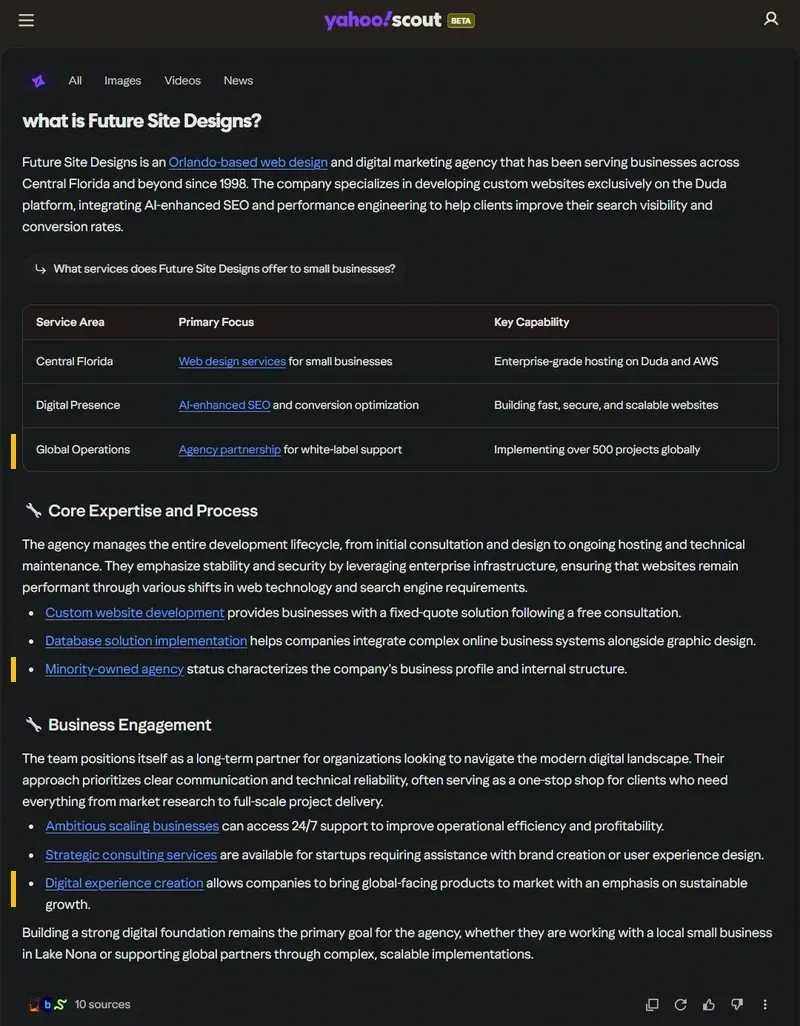
Engine Two: Seven Claims Not Stated on Our Site
The second engine returned a complete entity card — a structured summary of who we are, where we operate, how large we are, how long we have been working, and who we serve.
Roughly a dozen attributes on it traced cleanly to pages we publish: our city, our founding year, our platform, our infrastructure, our service area, our project types, and our consultation process, several reproduced close to word-for-word.
Seven did not:
- An ownership classification we have never claimed
- A description of our client base as global
- A years-of-experience figure
- A count of client implementations completed
- An employee-count range several times our actual headcount
- A second office in another state
- A reference to our "primary locations," plural
None of these seven appears on our website as a stated business attribute. That distinction is deliberate and it matters — our site does contain contextual references to individual clients located outside Central Florida, for instance. What it does not contain is a statement that our client base is global. A published fact, a contextual reference, and a machine-generated attribute are three different things, and the whole subject of this case study lives in the gap between them.
The seven, classified — because "wrong" is too blunt a word
A second office in another state
Sourced to our own published content — our site explicitly states that Future Site Designs has an office in Columbus, Ohio.
"Primary locations," plural
Sourced to our own published content — our site explicitly refers to Orlando and Columbus as locations we serve.
An employee-count range in the tens
Contradicted by current first-party facts — our team page names a fraction of that number
A count of client implementations
No identifiable source — not obviously false, but we have never counted it and cannot substantiate it
An ownership classification
No identifiable source — it appears nowhere in our published material
Client base described as global
No identifiable source — we do work outside Central Florida, but we do not state a global client base
A years-of-experience figure
Derived from a published fact — roughly what you get by subtracting our founding year from the current one
Why we are being this careful about our own complaint
The last row is the one that holds us to our own standard.
A years-of-experience figure is not an invention. Any reader — or any machine — can derive it from the founding date we publish on every page. That was arithmetic, not fiction.
The problem with it is different and more specific: it ages. We publish "established in 1998" precisely because a founding date is correct forever and a year count is wrong within twelve months. A derived figure inherits none of that discipline, and once it is circulating under our name we have no way to refresh it.
That is a real issue. It is not the same issue as being credited with an office in a state we have never operated in, and describing both with one word would be sloppy.
Looking For Where the Seven Came From
This is the part of the work that does not get written up candidly very often, so we are going to do it here.
Two are shaped like directory fields
Two are confirmed by our own published content
The second-office reference and the "primary locations" plural both concern a state we do not operate in. Two things on our side could plausibly contribute: a business profile in that state we had stopped maintaining, and a live article on this site written for contractors in that city.
We did not demonstrate that either one produced the claim. We are noting an association we can see, not a cause we proved.
One is derived from something we do publish
The years-of-experience figure is not an invention and does not need a source. Subtract our founding year from the current one and you land close to it. No page of ours states it, but the arithmetic is available to anyone.
Three have no identifiable source or exact published wording
The ownership classification, the description of our client base as global, and the count of client implementations
For these we looked and found nothing: not on our site, not in the search index, not in an archive. No page states them and no published fact yields them.
What we are not going to do
We had a theory about those three. It was plausible, it fit the pattern, and when we went to verify it against the live search index it did not hold up. So it is not in this case study.
This matters more than the theory would have. If a business publishes an attribution it cannot demonstrate, it has done the same thing it is complaining about — stated something confidently with nothing behind it. The standard has to apply in both directions or it is not a standard.
Where that leaves us
Here is the final breakdown of the seven unverified claims:
- 3 — Contradicted by current first-party facts
- 1 — Derived from a published fact
- 3 — No identifiable source or exact published wording
Separately, and on a different axis — these are observations about what some claims resemble, not proven sources, and they deliberately do not sum to seven:
- 2 — Have the shape of directory form fields
- 2 — Concern a geography we have signals about
Three claims about our company have no identifiable source and are not derivable from anything we publish. That is a harder problem than a bad directory listing, because a bad listing can be corrected. Here there may be nothing obvious to correct directly — no field to edit, no profile to claim, no page to fix.
Which points at the only reliable lever: you cannot correct your way out of this, so the first-party record has to be right, complete, and consistent from the start.
What the Comparison Does and Does Not Show
Visual Proof
What We Are Doing About It
A note on what follows: this is entity hygiene we are doing because it is worth doing, not a list of proven causes. We could not establish that any of these was the origin of a specific claim, and we are not going to imply otherwise.
First-party record
Consolidating duplicate paths to a single canonical URL per page, retiring the out-of-state business profile, reviewing content written for markets outside the service area, and removing aging figures such as years-of-experience counts wherever they appear.
Third-party listings
Auditing directory profiles, correcting the employee-count and ownership fields on any kept, and deleting those that cannot be claimed.
Structured data
LocalBusiness schema carrying foundingDate, foundingLocation, our actual numberOfEmployees, and exactly one address node, plus a visible fact block stating the same facts in plain sentences.
Scheduled re-check
Re-querying both engines 30 to 60 days after cleanup and recording which claims disappear, which persist, and whether either engine's citation behavior changes.
One claim present in an earlier capture of the second engine — an incorrect industry classification — was absent from the August 30, 2026 capture.
This work is in progress. This page will be updated with the re-query result rather than replaced.
What This Means for Your Business
1. Run the query logged out. A signed-in answer reflects your own history with the tool, not what a customer sees. This is the easiest way to get a falsely reassuring result.
2. Check more than one engine. Ours disagreed substantially. One engine's substantiable answer told us nothing about the other's.
3. Expect some claims to have no findable source — and plan for that. Three of ours did. You cannot correct what you cannot locate, which means the defensible position is a first-party record that is right and consistent before an engine ever reads it, not a cleanup campaign afterward.
4. Old profiles and listings keep talking. A dropdown filled in years ago is a structured fact that can be repeated back. Claim what is worth keeping, correct its fields, delete the rest.
5. Content about a place can become a geographic signal associated with your business. Publishing about a market you do not actually serve can introduce a geographic signal that may complicate how machines interpret your intended service area.
6. Write dates that do not age. "Established in 1998" is correct forever. A years-of-experience figure is wrong the moment the year turns — and one is circulating under our name.
7. Name your services once and use that name everywhere. The engine that read our site returned our service list in our exact wording. Consistency is what made that possibl
The Outcome
Two engines. One business. One question. From the first, an answer we could substantiate claim by claim. From the second, seven claims not stated on our site — three contradicted by current first-party facts, one derived from a published fact, and three with no identifiable source or exact published wording.
That reframes AI search visibility as a prevention problem more than a correction one. Some inputs can be found and fixed. Some cannot be found. The part fully within a business's control is the record it publishes itself — stated plainly, kept consistent, and readable by a machine.
What a business cannot do is fix a description it has never read.
Frequently Asked Questions
Why does AI describe my business incorrectly?
Answer engines assemble a business record from multiple sources — the website, the Google Business Profile, third-party directory listings, and previously indexed pages. When those sources disagree, the engine reconciles them without knowing which is authoritative. In our own test, one engine returned seven claims not stated as business attributes on our site: three contradicted by current first-party facts, one derived from a published fact, and three with no identifiable source or exact published wording.
How do I find out what AI says about my business?
Query several answer engines for your business by name, logged out or in a private session, and record the output verbatim. Break each result into individual claims and check every one against your published record. Anything you cannot substantiate is worth investigating.
Why does it matter whether I am logged in?
A signed-in answer can draw on your own account history with that tool, which means it may reflect what the machine has learned from you rather than what it tells a stranger. Our first capture did exactly this and looked considerably better than the real result. Always test logged out or in a private session.
Can incorrect information about a business be corrected in AI search?
There is no universal edit function for an AI-generated business answer. Some platforms offer feedback or reporting mechanisms for particular kinds of business information, but corrections generally have to be made at the underlying sources: resolving duplicate URLs, retiring stale business profiles, correcting or removing third-party listings, reviewing content that attaches the wrong geography to the business, and publishing authoritative first-party facts in structured data and visible copy.
How long does a correction take to reach AI search results?
It varies by engine and by source, and it is not immediate. We re-query 30 to 60 days after cleanup and track which claims clear and which persist — that is our measurement interval, not a general timeline. Any provider offering a guaranteed timeline for changing an AI-generated answer should be treated with skepticism.
Does schema markup fix incorrect AI answers?
Structured data is not a correction mechanism on its own. It gives an engine an authoritative first-party statement of facts it would otherwise have to infer — founding date, location, size, and service area. It works alongside correcting the conflicting sources, not instead of it.
Is auditing AI search results the same as managing online reviews?
No. Reviews are opinions about a business. This is factual attribute data — location, size, founding date, industry, service area — assembled and stated by a machine as fact. The correction path is technical rather than conversational.
What Does AI Say About Your Business?
That is an answerable question, and the answer is usually more surprising than a ranking report. We will run a free AI website audit and show you what answer engines can find about your business, what they are filling in on their own, and where your service area, platform, and profile data leave gaps.
Call 407-720-8540 or get in touch. Future Site Designs has been building websites in Orlando and across Central Florida since 1998.