

Rebuilding Reliance for Speed, Scale & Machine Readability
Reliance needed a faster, more scalable website capable of delivering a better experience across mobile and desktop while providing search engines and AI systems with a clear understanding of its services and content.
Starting from a 34% baseline, we executed a ground-up architectural rebuild focused on performance, technical structure, mobile usability, and machine readability.
34% → 90+
Mobile Performance Score
96
Technical Best Practices
Duda / AWS
Scalable Platform Architecture
The Challenge
The existing website faced performance limitations that affected the user experience, particularly on mobile devices. The rebuild needed to address more than visual design—it required a stronger technical foundation capable of supporting Reliance's high-resolution portfolio imagery, services, and future growth.
The Execution
The rebuild addressed Reliance's website at the architectural level, combining platform modernization, performance engineering, semantic structure, and mobile-first design. Each improvement was implemented as part of a unified technical strategy designed to create a faster, more stable, and more understandable digital experience.
1. Platform Migration to a Scalable Architecture
We migrated Reliance's website from its legacy WordPress environment to the Duda platform, hosted on AWS.
The migration eliminated reliance on a large collection of third-party plugins while providing a more streamlined platform architecture and CDN-backed content delivery. The result was a more secure, maintainable foundation designed for improved performance and scalability.
2. Core Web Vitals Optimization
We implemented a comprehensive performance optimization process focused on the metrics that directly affect the user experience.
- Largest Contentful Paint (LCP): Optimized high-resolution portfolio imagery using modern WebP formats and applied strategic loading techniques to improve image delivery without unnecessarily delaying above-the-fold content.
- Cumulative Layout Shift (CLS): Established defined dimensions and aspect ratios for media and form elements to minimize unexpected movement during page rendering.
- Overall Performance: Reduced unnecessary page weight and optimized the delivery of critical assets to create a faster, more stable browsing experience.
3. Semantic Structure & Answer Engine Optimization
Performance is only one part of modern search visibility. We also rebuilt the site's underlying structure to make its content easier for search engines and AI systems to interpret.
The implementation incorporated semantic HTML and JSON-LD structured data, including relevant LocalBusiness and Service schema, creating clearer relationships between Reliance, its services, and its business information.
This provides a stronger technical foundation for traditional search, local search, and emerging answer-engine experiences.
4. Mobile-First Engineering
Because contractor and remodeling searches frequently begin on mobile devices, the experience was engineered with mobile usability as a priority.
We streamlined navigation, optimized tap targets, simplified the path to project information, and designed portfolio and inquiry experiences to work smoothly across smaller screens.
Performance Matters
Visual Proof
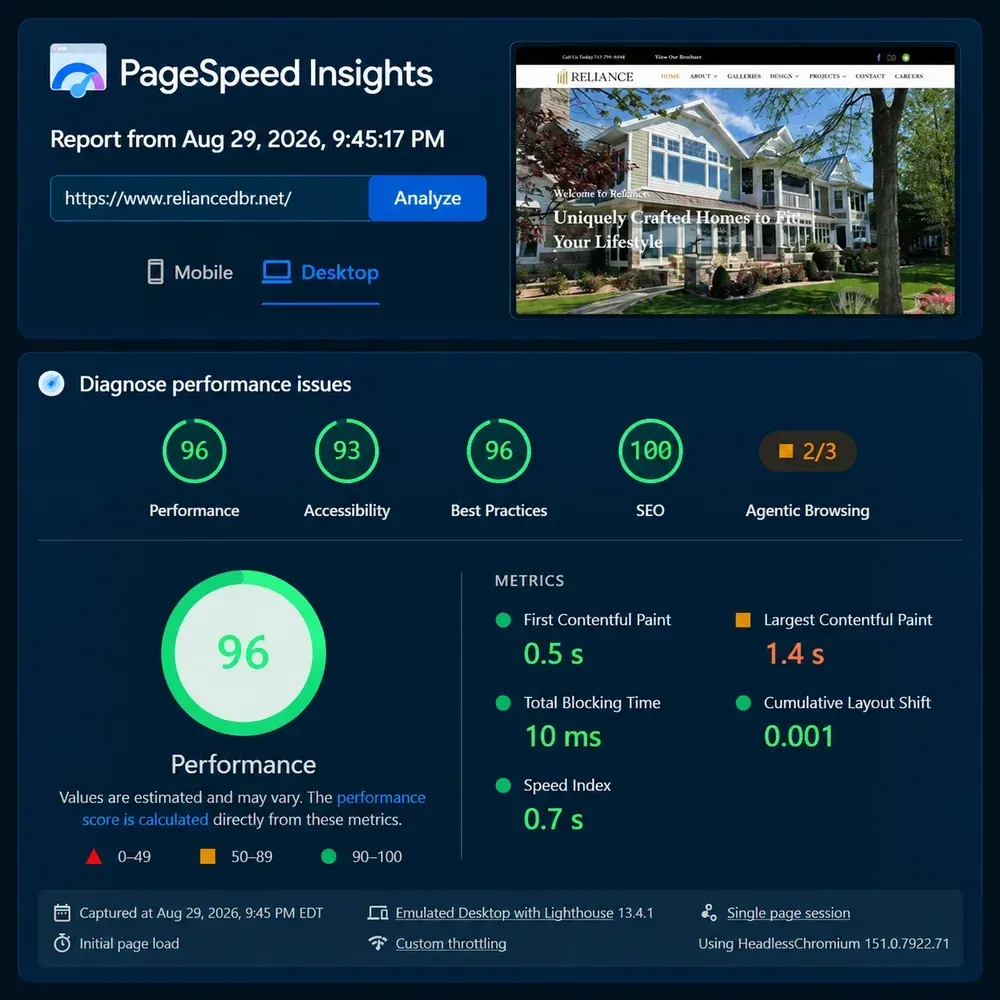
Mobile Performance Score
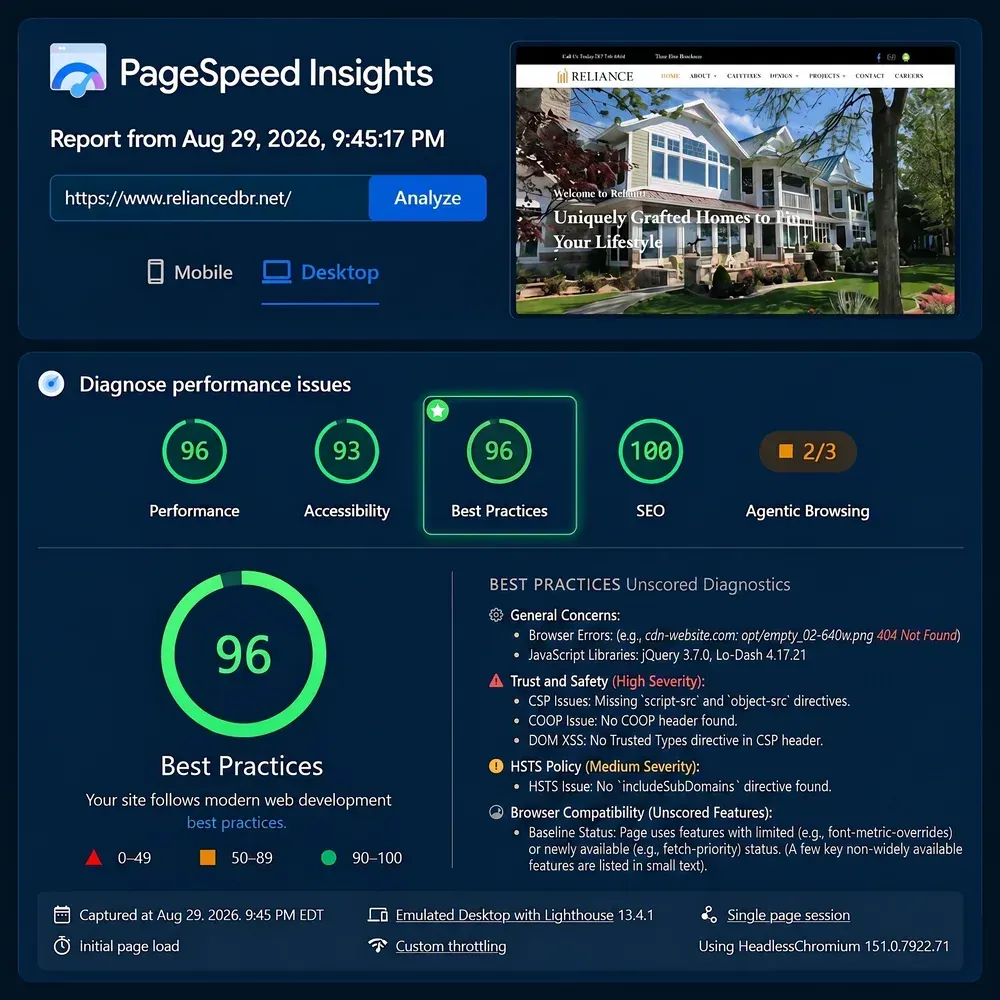
Technical Best Practices
Results & Impact
Built to Perform. Structured to Be Understood. Designed to Convert.
Performance
Improved the baseline from 34% to consistent 90+ scores in the green tier across the tested performance environment.
Core Web Vitals
Achieved a 100% Core Web Vitals pass rate.
Answer Engine Optimization (AEO)
Implemented structured entity and service data to improve machine readability and search-engine understanding.
Mobile Experience
Reduced friction throughout navigation, portfolio browsing, and project inquiry paths.
Scalable Foundation
Moved Reliance to a streamlined Duda/AWS architecture designed for ongoing performance and content growth.
The Outcome
Reliance's new website isn't simply a redesigned brochure. It is a performance-focused digital platform engineered to load efficiently, communicate its services clearly to search engines, AI systems, and users, and provide a smoother path from search to project inquiry.
Frequently Asked Questions
Will my website lose its current SEO rankings during a platform migration?
A platform migration does not inherently mean losing search visibility. The key is preserving the site's existing URL structure and search signals throughout the transition. We use comprehensive URL mapping, implement appropriate 301 redirects, preserve important metadata and content, and test the new environment before launch to help transfer existing authority and minimize disruption.
How long does a website migration and Core Web Vitals rebuild take?
The timeline depends on the size and complexity of the existing website, but a professional migration requires more than simply rebuilding the pages. The process includes content and URL mapping, technical implementation, staging, performance optimization, redirect testing, mobile testing, and launch verification. For a typical small-to-mid-sized business website, the technical rebuild and migration can often be completed within several weeks, with the exact timeline determined during project planning.
Why is my current WordPress website failing mobile performance tests?
Poor mobile performance can result from several factors, including excessive plugins, large unoptimized assets, inefficient scripts, slow server response times, and page builders that generate unnecessary code. A performance-focused rebuild addresses these issues at the architectural level rather than relying solely on surface-level speed fixes. The goal is a lighter, more efficient experience that performs consistently across real-world mobile conditions.
Do you guarantee a 90+ performance score?
No responsible developer can guarantee an exact PageSpeed score under every testing condition. Performance results can vary based on device, network conditions, browser environment, and third-party services. Our objective is to engineer the site toward consistent green-tier performance and passing Core Web Vitals, using measurable optimization, testing, and technical best practices rather than promising an arbitrary score.