

How Long Does It Take to Build a Website?

Most small to mid-sized business websites take 4 to 8 weeks to build, from kickoff to launch. A simple brochure site can go live in about 3 to 4 weeks, an e-commerce store usually runs 6 to 10 weeks, and a larger custom project can take 8 to 12 weeks or more. The single biggest factor is not the design work — it is how quickly you provide content and approve each round of feedback. At Future Site Designs, we have built sites for Orlando and Central Florida businesses since 1998, and the projects that launch fastest are the ones where the owner has their content ready before we start.
The Short Answer, by Type of Website
Not every website takes the same amount of time. Here is a realistic range for each common type of small business site:
- Brochure / informational site (a few pages): about 3 to 4 weeks. Home, About, Services, and Contact with no complex functionality.
- Standard small business site (5 to 10 pages): about 4 to 8 weeks. The most common project, with service pages, a gallery or portfolio, and lead forms.
- E-commerce store: about 6 to 10 weeks. Product setup, payment and shipping configuration, and checkout testing add time. See our e-commerce web design page for what that build involves.
- Larger or custom project: 8 to 12 weeks or more. Many pages, custom features, integrations with other software, or content that still needs to be written or produced.
Timeline and cost usually track together — for what each type of site runs, see our breakdown of the real cost of website design.
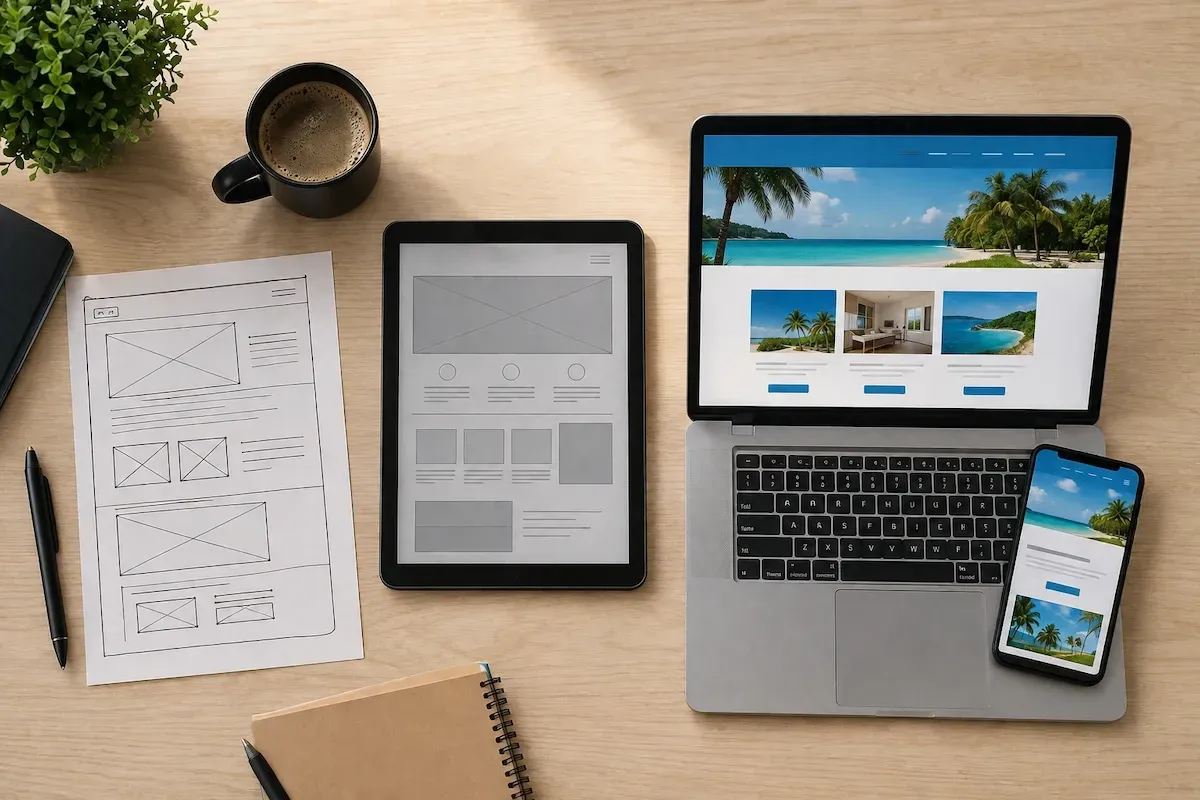
The 5 Phases of a Website Build
Every project moves through the same five phases. Knowing what each one involves helps you see where the weeks go — and where you can speed things up.
Phase 1: Discovery and Planning (about 1 week)
We learn your business, your customers, and your goals, then map out the pages and the structure of the site. This is also when we gather your brand assets — logo, colors, photos — and confirm what content exists and what still needs to be created. Time spent here is never wasted; a clear plan is what keeps the rest of the project on schedule.
Phase 2: Design (about 1 to 2 weeks)
We design the look and layout of your key pages so you can see and approve the direction before the full site is built. You review, we refine. Most projects settle the design in one or two rounds of feedback.
Phase 3: Build and Development (about 1 to 3 weeks)
This is where the approved design becomes a working website. We build every page, wire up your forms, set up mobile layouts, and connect anything the site needs to do. We build exclusively on the Duda platform, which shortens this phase because the mobile version is generated alongside the desktop version rather than built separately.
Phase 4: Content and Review (about 1 to 2 weeks)
We load in your text, images, and any video, then walk the whole site with you for a final review. This phase stretches or shrinks almost entirely based on one thing: whether your content is ready. Waiting on copy or photos is the most common reason a website launch slips.
Phase 5: Testing and Launch (a few days)
Before your site goes live, we test it on phones, tablets, and desktops, check every link and form, and confirm it loads fast and displays correctly. Then we launch, point your domain, and make sure everything is running. We also handle your
DNS and email security so nothing breaks when the domain moves.
What Actually Determines Your Timeline
Two projects of the same size can finish weeks apart. Here is what makes the difference:
- How ready your content is. Text and photos that are ready on day one are the fastest way to a fast launch. Content that gets written during the project is the most common cause of delay.
- How quickly you give feedback. Every review round that sits for a week adds a week. Prompt approvals keep momentum.
- How many revision rounds you need. A clear vision up front means fewer rounds later. This is one reason it pays to choose the right designer before you start.
- The size and complexity of the site. More pages, e-commerce, and integrations with other tools all add time.
- Whether new photos or video are needed. Producing new visuals runs alongside the build, but it does add to the schedule.
How to Make Your Website Project Go Faster
You have more control over the timeline than you might think. To launch sooner:
- Gather your content first — your service descriptions, key photos, logo, and any reviews or testimonials — before the project starts.
- Decide who on your side has final say, so approvals do not stall waiting on a group.
- Give feedback in one consolidated pass per round instead of a trickle of separate notes.
- Be honest about your must-haves versus nice-to-haves, so the first launch is not held up by extras that can be added later.

Frequently Asked Questions
Can a website be built in a week?
A small, few-page site with content already prepared can sometimes launch in about a week, but that is the exception. For most small business websites, a realistic timeline is 4 to 8 weeks once you factor in design approvals and content. Rushing the review stages usually costs more time later in fixes than it saves up front.
How long does an e-commerce website take to build?
An online store typically takes 6 to 10 weeks. Beyond the design and pages, an e-commerce build includes setting up products, configuring payment and shipping, and thoroughly testing the checkout before launch. The more products you have, the longer the setup.
Why does content slow a website project down?
Design and development can move quickly, but a website cannot launch with empty pages. When copy and photos are still being written or gathered during the project, the whole timeline waits on them. Preparing your content before the build begins is the most reliable way to launch on schedule.
Does a faster build mean a lower-quality website?
No — speed comes from preparation and an efficient platform, not from cutting corners. Because we build on Duda, the mobile version is created alongside the desktop version and the hosting is fast and secure out of the box, so a well-prepared project can move quickly without sacrificing quality or
performance.
Ready to Start Your Website?
If you are planning a new website for your Orlando or Central Florida business, the fastest path to launch starts with a clear picture of where your current site stands. Get a free AI and speed audit and we will show you exactly what to prioritize — then map a realistic timeline for your project.
Prefer to talk it through?
Contact us or call
407-720-8540 — we build websites for businesses across Orlando, Lake Nona, Belle Isle, Pine Castle,
Kissimmee, and Central Florida.
Future Site Designs Knowledge Center



About the Author: Jeromy Schall
Jeromy Schall founded Future Site Designs, an Orlando web design and digital marketing agency, in 1998. His work focuses on website development, technical SEO, website performance, and digital strategies that help businesses reach customers online.
Digital Strategist and Founder
Jeromy has led Future Site Designs since 1998, from static HTML sites to today’s AI-driven search. He shares practical guidance in the
Knowledge Center on AI-driven SEO, website design, search visibility, and mobile performance.
Website Strategy and Client Leadership
eromy leads sales and client strategy directly and is the point of contact on every project. Each site is planned around what the client’s business needs to grow, with clear communication and practical recommendations throughout.
AI-Driven SEO and Web Engineering
Jeromy builds exclusively on the Duda platform, hosted on AWS. His expertise includes technical SEO, website performance, secure website infrastructure, and structuring content so it’s eligible to be cited by AI Overviews, ChatGPT, Gemini and Perplexity. Future Site Designs also provides white-label website development for agencies.
Media Production and Broadcasting
Beyond the agency, Jeromy is an active broadcaster and media producer in the international waterskiing community, covering world-class competitions. That hands-on media experience feeds directly into the agency’s video production work.